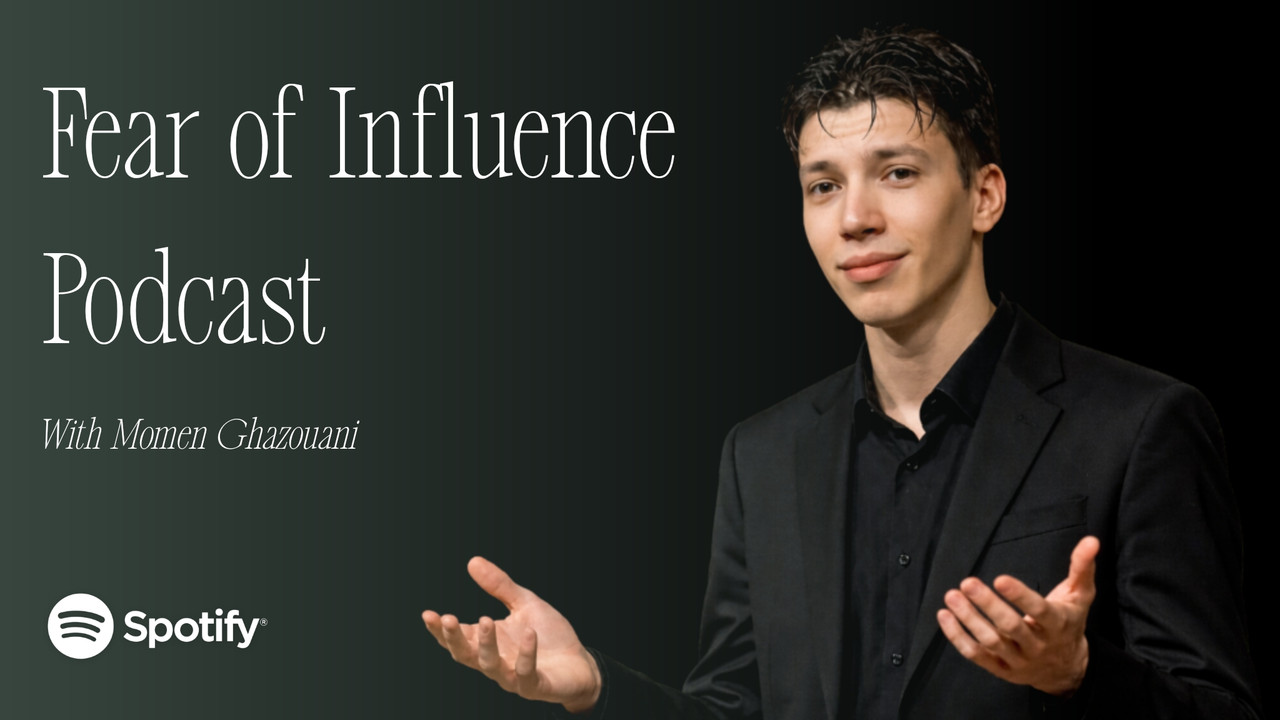

There is a piece of advice repeated so often that it has stopped being examined: just start, don't be a coward. On the surface it sounds like courage. In practice, I have watched it become something else entirely. It has become a license. People hear it as permission to project before they possess anything worth projecting. They mistake the instruction to begin for an instruction to appear, and the two are not the same thing.
I want to be precise about what is being misunderstood here, because the confusion is not trivial. To start does not mean to perform readiness. It does not mean manufacturing a version of yourself that looks finished before anything inside you actually is. When people compress "begin" into "look the part immediately," they skip the only step that gives beginning any meaning: the interior work of forming a position, a conviction, a way of seeing that is actually yours. What they produce instead is not a start. It is a costume worn before the character exists.
This is where I locate the origin of a broader problem, one I would call visual pollution. When enough people confuse appearance with substance, the result is not a landscape of strong individuals. It is a landscape saturated with signals that carry no weight, because none of them were earned. Feeds fill with the aesthetics of leadership: the studio lighting, the curated backdrop, the language borrowed from people who spent years arriving at it honestly. What is missing is the years. What is missing is the arriving. The result is an illusion of leadership, a kind of noise that imitates authority without holding any of its actual mass, and it disorients everyone, including the people producing it, because eventually even they cannot tell what they built from what they borrowed.
The Mechanism Beneath Confidence
I want to be careful here, because I am not interested in sorting people into two permanent categories. Human beings are not that simple, and any framework that claims to file a person neatly under "image type" or "voice type" is lying to you for the sake of tidiness. What I have observed instead is a mechanism, not a personality, and it reveals itself in a specific moment: the moment of error.
When someone whose confidence is rooted in voice makes a mistake, something interesting happens. They do not collapse, because the mistake was never the foundation of their standing in the first place. Their conviction did not depend on being flawless. It depended on being honest about what they actually think, and an error does not threaten that. It simply becomes information. This is why people who operate from voice tend to absorb criticism without flinching. Being wrong costs them accuracy, not identity.
Contrast this with confidence that rests primarily on image. Here, error is dangerous in a different way, because the entire structure was built on the appearance of having it together. A visible mistake does not just cost accuracy. It threatens the whole surface. What follows is often a noticeable avoidance of risk, a carefulness that, if you watch closely, starts to look less like discipline and more like fear wearing discipline's clothes.
I want to state clearly that this is not a verdict on anyone's character. It is a pattern that surfaces at a particular moment, and the same person can show one version of it on one day and the other version on another. What I would ask of you is not to use this as a lens for judging others, sorting the people around you into categories and dismissing whoever lands in the wrong one. Extract what is useful from anyone, regardless of which side of this pattern they happen to be standing on today, and refuse the temptation to file them away. The moment you turn a pattern into a permanent label, you have stopped thinking and started sorting, and sorting is exactly the shortcut this entire argument is trying to move you away from.
Those Who Built the Voice Before the Face
History does not lack examples of this sequence playing out, and I prefer to describe the shape of it rather than attach it to any single name, because the pattern matters more than the person. Consider the archetype of the early thinker who writes, argues, and refines a position for years inside rooms that offer no visibility at all. No audience. No image. Only the discipline of returning to an idea until it becomes something solid enough to survive contact with disagreement. When recognition eventually arrives for this kind of person, it does not create the substance. It only makes visible what was already there.
Compare this to the more familiar contemporary pattern: presence built first, position assembled after the fact. Here the visibility arrives before the conviction is settled, and what follows is a kind of scrambling, a search for content and stance sturdy enough to justify the platform that was constructed in advance. It rarely holds, because it was built backward. The image asked a question that the voice had not yet answered.
I did not wait until I looked ready. I spoke before I was seen, and because the speaking came first, when visibility eventually arrived, it arrived as confirmation rather than as introduction. That ordering is not a minor detail. It is the entire argument.
Why I Will Not Give You Seven Steps
I am aware that at this point, convention expects a list. Seven steps to build your voice. A framework, numbered, digestible, shareable. I want to tell you plainly why I am not going to give you one, and I want that refusal itself to function as the answer, not as an evasion of it.
Every time I have tried to compress this into a checklist, I notice the same thing happening: I am flattening years of internal friction into a sentence and calling it a step. Step one, know your convictions. As if convictions arrive on schedule, as if they do not take the shape they take precisely because you fought for them slowly, inconsistently, often without knowing you were fighting at all. A framework promises a shortcut through exactly the part of the process that cannot be shortcut. The moment I hand you a numbered list, I have quietly told you that voice can be manufactured on a timeline, and that claim is false in the same way the "just start" advice was false when it was misread as permission to skip the interior work.
So here is what I will say instead, without disguising it as a procedure. If you are asking me for a method, you are still thinking like someone producing content rather than someone forming a position, and that distinction is the actual fork in the road. A content producer wants output that performs. A thinker with a real voice wants to be right, or at least honest, more than they want to be seen, and that priority cannot be scheduled into seven steps because it is not a task. It is an orientation you either hold or you do not, one you strengthen the same way you strengthen anything real: slowly, through repetition, through disagreement survived, through positions revised in public when the evidence demanded revision.
You define your own level. Either you are someone building a voice, with everything that costs in patience and exposure to being wrong, or you are someone producing content, optimizing for a rhythm that visibility rewards. Both are legitimate activities. They are simply not the same activity, and confusing them is the mistake this entire piece is trying to name.
Voice Does Not Always Mean Speech
I want to widen the definition I have been using, because I have so far spoken as though voice necessarily means words, spoken or written. It does not. There is no single path to influence. Some people move others through speech, and some move them through a silence that says everything.
This distinction matters more than it might first appear. We live inside a culture that measures impact by volume, by eloquence, by constant visibility, and that measurement quietly implies that anyone who is not speaking is not contributing. I do not think that is true. Not everyone who makes a difference speaks, and not everyone who stays quiet is absent from the room.
Some people carry the gift of articulation. They build bridges out of language, they move a room through argument, and they transform an idea by putting it into words other people had not yet found for themselves. That is a legitimate form of influence, and I would never diminish it. But there is another form, quieter and just as real. There are people whose mark is left through restraint. Their gaze carries a message their mouth never delivers. Their refusal to join a chaotic exchange teaches a kind of composure that a paragraph could not teach as efficiently. Their patience under difficulty becomes, without a single sentence spoken, a lesson in what endurance actually looks like.
If this framing is accurate, then the task in front of each person is not to imitate whichever mode is currently rewarded by visibility. It is to identify which form is actually yours, and refine it rather than replace it. If your instrument is language, use it with sincerity, not performance. If your instrument is a considered stillness, do not treat that as a deficiency you need to correct by forcing yourself into a register that was never native to you. Make the silence deliberate rather than accidental, because a silence that is chosen carries weight, and a silence that is merely an absence of anything to say does not.
What both forms share, and what actually determines whether either one produces real influence, is authenticity. It is not whether you move people through words or through restraint that matters. It is whether either one is sincere. A performed silence is as hollow as a performed sentence. A genuine one, in either direction, reaches people even when nothing at all was said.
The Practical Weight of This Distinction
It is worth being specific about where this shows up, because an idea this abstract can start to feel decorative if it is never brought down to ground level.
In a professional setting, this distinction determines how a person leads a team. Some leaders inspire through a clear, well argued position stated aloud in the room. Others inspire through a quiet, unmovable stance that a team learns to read without needing it explained. Both are forms of leadership. Neither is a lesser version of the other.
In personal relationships, the same logic applies. There are moments where silence is the more respectful response, and moments where speaking becomes necessary because silence would be read as absence rather than restraint. Knowing which moment you are in is closer to an art than a rule, and no framework will make that judgment for you.
In mentorship or education, the pattern repeats again. Not every student responds to explicit instruction. Some learn more from watching a quiet, consistent example than from any amount of spoken guidance, and a mentor who only knows how to teach through speech will miss the students who needed something else from them.
Conclusion: The Image as Reflection, Not as Objective
I return now to the question I opened with. How do you stand out in a world this loud. I still believe the answer is the same one I gave at the start, though I hope it now carries more weight than it did before the argument that led here. Do not begin with your image. Begin with your voice, in whichever form it actually takes for you, spoken or restrained, and let the substance accumulate honestly before you allow it to become visible.
The image, when it eventually arrives, should not be the objective you were working toward. It should be a reflection of something that was already true before anyone was watching. I recognize the tendency in my own writing, particularly on intellectual subjects, to close every gap with a strict and almost academic rigor, even on the simplest of topics, until the result reads as heavier than it needed to be. I accept that cost. I would rather the reflection be accurate and dense than easy and hollow, because the entire argument I have made here rests on exactly that preference: substance first, visibility after, and never the reverse.